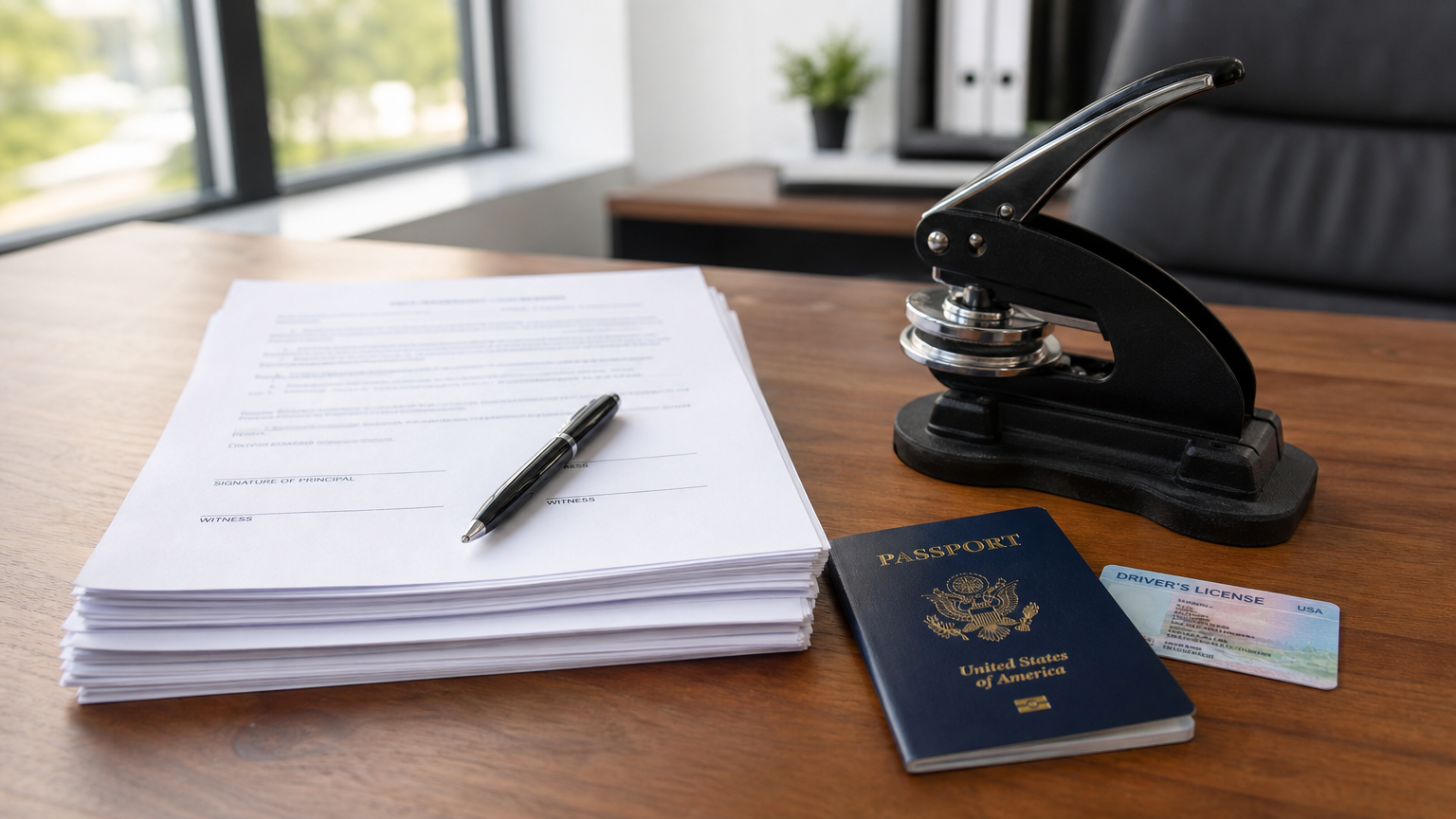
Introduction
Buying real estate outside Canada is common for vacation homes, investments, or family reasons. Regardless of your motive, Canadian notarized documents usually need extra steps before a foreign land registry, notary, or government office will accept them. This guide outlines which papers are typically required, how international authentication works, and practical planning tips to keep your closing on track.
One crucial aspect of this process is notarization, which ensures your documents are properly validated for use abroad.
Why a Canadian Notary Seal Isn’t Always Enough
A notary’s signature and seal are valid within Canada, but foreign authorities cannot independently confirm a Canadian notary’s credentials or authority. International document authentication creates a government-recognized chain of confirmation so the receiving authority can trust the signature.
Notarization is usually the first step. After that, documents either receive an apostille or go through authentication and legalization, depending on whether the destination country is a member of the Hague Apostille Convention. An apostille is a single certificate that replaces the multi-step legalization process for Hague members; non-member countries generally require the older two-step authentication and legalization procedure.
Before you prepare documents, confirm whether the country where the property sits is a Hague Convention member. Check with that country’s embassy or consulate in Canada to determine the exact path required.
Common Documents Required for Foreign Property Transactions
Requirements vary by country and transaction type, but most foreign closings ask for some combination of the following documents:
- Power of attorney — Often required when you cannot attend in person; it authorizes a local representative to sign and act on your behalf.
- Certified true copies of identity documents — Passports and government photo ID are commonly requested to verify identity.
- Title or deed documents — Proof of ownership or legal interest in the property.
- Marital status certificates — Marriage or divorce certificates may be needed for ownership or tax purposes.
- Death certificates or probate documents — Required when property rights pass through an estate.
- Corporate documents — If a company or trust is buying, incorporations, bylaws, resolutions, and director attestations are typical.
- Local forms and affidavits — Jurisdiction-specific forms, declarations or translation certifications may be requested.
Authentication Paths: Apostille vs. Full Legalization
There are two principal paths after notarization:
- Apostille (single-step) — If the destination country is a member of the Hague Apostille Convention, an apostille attaches to the notarized document and confirms the notary’s authority for that country’s authorities.
- Authentication and legalization (two-step) — For countries not in the Convention, your documents typically need provincial or federal authentication followed by legalization at the destination country’s embassy or consulate. This process can be lengthier and involve several government offices.
Which route applies has a direct effect on timing, cost, and the number of handoffs a document will have before it is accepted abroad.
Typical Step-by-Step Process
While local variations exist, a common sequence is:
- Have the document properly notarized by a Canadian notary public.
- Obtain any required certified true copies and translations.
- Confirm whether an apostille or full legalization is required for the destination country.
- If an apostille applies, request it from the appropriate Canadian authority designated for that purpose.
- For non-Hague countries, follow the authentication process (provincial or federal), then submit to the destination country’s embassy or consulate for legalization.
- Deliver legalized documents to your local point of contact abroad—lawyer, notary, or land registry—well ahead of the closing.
Planning Your Timeline and Avoiding Delays
Authentication and legalization steps add time. Delays at any stage can push a closing back by weeks. To reduce risk:
- Confirm document requirements with the foreign lawyer, notary, or land registry before you begin.
- Contact the destination country’s embassy or consulate in Canada to verify whether the Hague Apostille Convention applies and to learn their specific acceptance rules.
- Allow extra time for courier services, government processing, and any required translations.
- Use local legal representation abroad when possible; they can confirm precise document formats, translations, and witnessing rules.
- Prepare original documents and certified copies as requested—some offices reject photocopies or improperly certified copies.
Common Pitfalls
Be aware of these frequent issues that cause rejected documents or delays:
- Assuming notarization alone is sufficient.
- Failing to verify whether an apostille or consular legalization is required.
- Not allowing enough time for processing and international delivery.
- Using incorrect or incomplete translations.
- Relying on outdated information—requirements can change, so always reconfirm close to the transaction date.
Conclusion
When buying property abroad, notarization is only the first step toward making Canadian documents acceptable to a foreign authority. Determine whether the destination country requires an apostille or full authentication and legalization, confirm the exact list of documents with local representatives, and build extra time into your schedule. Proper preparation helps prevent last-minute surprises and keeps your closing on track.
Essential guidance on NDA notarization in Ontario: when it’s required, how the process works, and how to prepare for a smooth notarization.
Essential vehicle transfer guidance for Ontario buyers and sellers, plus when notarization and statutory declarations are required.